SCHOLA CANTORUM OF SANTA FE
Santa Fe's Sacred Music Ensemble
A Sacred Music Concert in honor of St. Jude Thaddeus Feast Day, 2026
I want to be on Schola's email distribution!
Los Peces en El Río
Traditional 16th century Villancico of Spain
This popular Spanish villancico seems to draw a contrast between the fishes in the river, who are excited about the birth of Jesus, and the Virgin Mary and her chores of daily life.
But this villancico is filled with complexity – hidden meanings, Moorish (Arabic) musical structure and tonalites, transformation of a secular song into a religious song (as was popular in 16th century Spain where secular texts were adapted "to the divine," transforming them into compositions with religious content), and hidden imagery (the Virgin is combing her golden hair with a comb made of silver – a nod to Spain’s Golden Age of 1492 to 1681).
La Virgen se está peinando
entre cortina y cortina,
sus cabellos son de oro
y el peine de plata fina.
The Virgin is combing her hair
between the curtains,
her hairs are of gold
and the comb is of fine silver.
Estribillo:
Pero mira como beben los peces en el río,
pero mira como beben por ver a Dios nacido.
Beben y beben y vuelven a beber,
los peces en el río por ver a Dios nacer.
Refrain:
But look how the fishes in the river drink,
but look how they drink to see God born.
They drink, and drink, and drink again,
the fishes in the river to see God born.
La Virgen lava pañales
y los tiende en el romero,
los pajarillos cantando
y el romero floreciendo.
The Virgin washes diapers
and hangs them in the rosemary,
the birds are singing
and the rosemary is flowering.
La Virgen se está lavando
con un poco de jabón,
se le han picado las manos
manos de mi corazón.
The Virgin washes herself
with a little bit of soap,
her hands have become itchy,
the hands of my heart.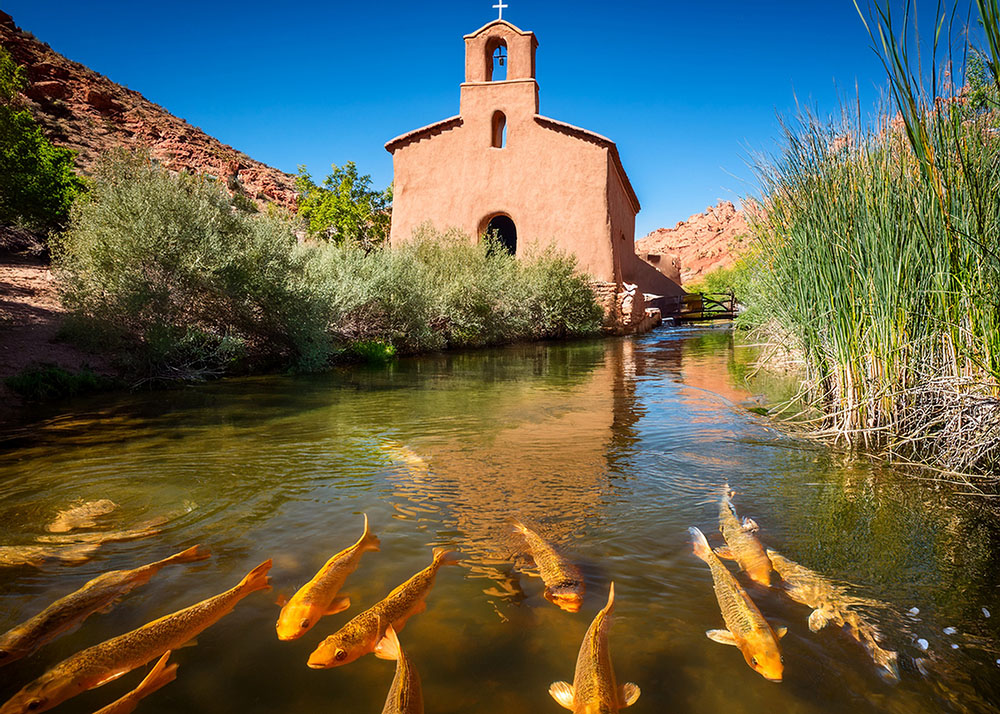
Canto de María
Mary's Song - Magnificat
Rev. Monsignor Lambert Luna (New Mexico, b. 1952)
New Mexico's Monsignor Lamber Luna composed this setting of the Magnificat in the Spanish language.
Proclama mi alma la grandeza del Señor.
Se alegra mi espíritu en Dios mi Salvador.
My soul proclaims the greatness of the Lord.
My spirit rejoices in God my Savior.
1. Porque ha mirado la⏝humillación de su⏝esclava, de su⏝esclava.
Desde⏝ahora todas las gentes siempre me felicitarán.
1. For He has looked upon the lowliness of His handmaid.
From now on, all generations shall call me blessed.
2. Porque⏝el Poderoso ha hecho obras grandes por mí,
porque⏝el | Poderoso es Santo, su nombre es San-to.
2. For the Mighty One has done great things for me,
for the Mighty One is Holy; His name is Holy.
3. Y su misericordia llega a sus fieles hoy y siempre;
hace proezas con su brazo, dispersa⏝a los sober-bios.
3. And His mercy reaches the faithful today and forever;
He performs mighty deeds with His arm; He scatters the proud.
4. A los poderosos derriba de sus tronos, los derriba,
y⏝enaltece a los humildes, los humildes de corazón.
4. He casts down the mighty from their thrones, casts them down,
and exalts the the humble of heart.
5. A los ham-brientos los colma de sus bienes, Dios los colma,
y⏝a los ricos los despide, los despide vacíos.
5. He fills the hungry with good things — God fills them —
and sends the rich away, sends them away empty.
6. Auxilia a Israel, Israel su siervo,
acordándose con ternura de su misericordia.
6. He comes to the aid of Israel, Israel His servant,
remembering His mercy with tenderness.
7. Como⏝a nuestros padres lo⏝había prometido, prometido,
en favor de Abrahán y su descenden-cia.
7. Just as He had promised our ancestors, promised,
for the sake of Abraham and his descendants.
There is No Rose of Such Virtue
15th century anonymous English carol
The poem inside this 15th song explores the mystery of the Incarnation (God becoming human), marveling at how something as vast as heaven and earth could be contained within a single womb. The "rose" is a traditional medieval symbol for the Virgin Mary.
Each stanza introduces an idea in English and concludes with a profound Latin phrase:
• Alleluia (Praise be to God)
• Res miranda ("A wonderful thing/marvel") — referencing how heaven and earth were contained in a little space.
• Pari forma ("Of equal form") — expressing that Jesus is of the same divine nature as the Trinity.
• Gloria in excelsis Deo / Gaudeamus ("Glory to God in the highest / Let us rejoice") — what the angels sang to the shepherds.
• Transeamus ("Let us cross over / follow") — urging the listener to leave worldly mirth and follow this joyful birth.
There is no rose of such virtue
as is the rose that bare Jesu.
1. There is no rose of such virtue
as is the rose that bare Jesu;
alleluia. (praise God.)
2. For in this rose contained was
heaven and earth in little space;
res miranda. (a wonderous thing.)
3. By that rose we may well see
that he is God in persons three,
pari forma. (equal in form.)
4. The angels sung the shepherds to:
Gloria in excelsis deo:
gaudeamus. (glory to God in the highest:
let us rejoice.)
5. Leave we all this worldly mirth (amusement, laughter, or happiness),
and follow we this joyful birth;
transeamus. (let us go forth.)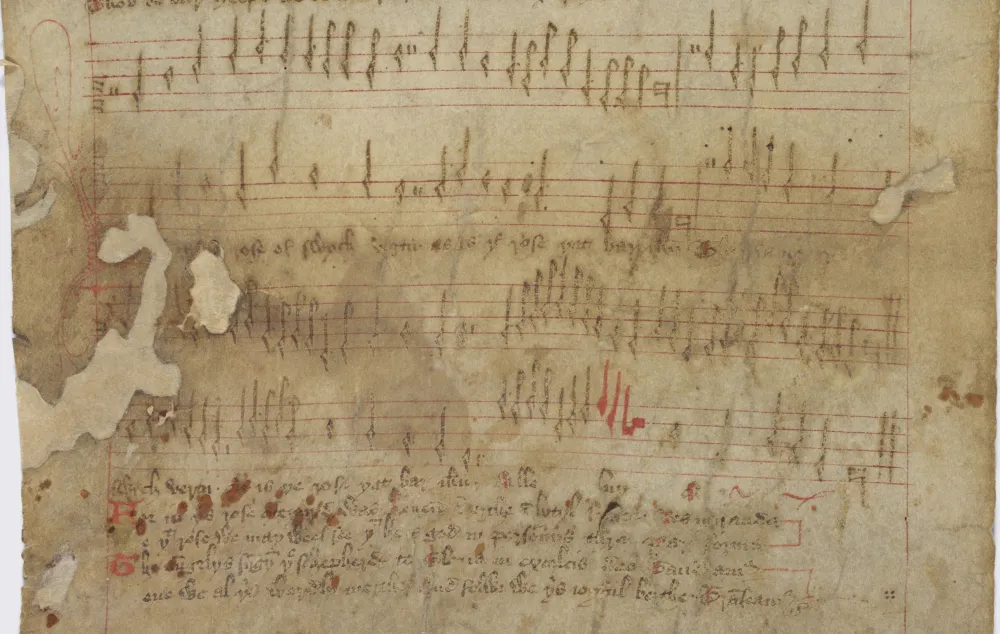
Photo of the 15th century ‘There is no rose’.
Magnificat octave toni
Magnificat according to Gregorian chant tone eight
Dufay, Guillaume (b. near Beersel, Belgium 1397; died Cambrai, France
1474)
Dufay, the brilliant early Renaissance composer, set this three-part magnificat for use during Vespers in Old St. Peter's in Rome. With the construction of the "new" Sistine Chapel in the early 1500s, Dufay's Magnificat octave toni was copied for Vespers in this new chapel that was exclusively for the pope's use.
The Magnificat is known as the Canticle of Mary and the text is found in the Gospel of St. Luke. In Mary’s canticle, her first words, Magnificat anima mea Dominum, from which comes the title, translates into English as “My soul proclaims the greatness of the Lord.” The Lord has bestowed on her to be the mother of the Christ child. The text describes God’s promises fulfilled through the ages and now the greatest of all fulfilled through her. St. Benedict decreed in his Rule of St. Benedict that the Magnificat, originally sung as a Gregorian chant, be sung daily during the office of Vespers. The Magnificat is still sung today during Vespers.
And Mary said…"my soul proclaims the greatness of the Lord…"
1. “Magníficat ánima méa Dóminum,
My soul magnifies (proclaims the greatness of) the Lord,
2. Et exultávit spíritus méus in Déo salutári méo.
And my spirit rejoiced in God my Savior.
3. Quia respéxit humilitátem ancíllæ súæ,
ecce enim ex hoc beátam me dícent ómnes generatiónes.
For he has looked with favor on his lowly servant.
For behold, henceforth all generations shall call me blessed.
4. Quia fécit míhi mágna qui pótens est :
et sánctum nómen éjus.
For he who is mighty has done great things for me,
and holy is his name.
5. Et misericórdia éjus a progénie in progénies
timéntibus éum.
And his mercy on those who fear him in every generation.
6. Fécit poténtiam in bráchio súo :
dispérsit supérbos ménte córdis súi.
He has shown the strength of his arm,
he has scattered the proud, even the arrogant of heart.
7. Depósuit poténtes de séde,
et exaltávit húmiles.
He has deposed the mighty from their thrones,
and has lifted up the status of the lowly.
8. Esuriéntes implévit bónis :
et dívites dimísit inánes.
He has filled the hungry with good things,
and the rich he has sent away empty.
9. Suscépit Israël púerum súum,
recordátus misericórdiæ súæ.
He has come to the help of his servant Israel
for he has remembered his promise of mercy,
10. Sicut locútus est ad pátres nóstros,
Abraham et sémini éjus in saécula.
the promise he made to our fathers,
to Abraham and his children forever.
11. Glória Pátri et Fílio et Spirítui Sáncto.
Glory be to the Father, and to the Son, and to the Holy Spirit,
12. Sicut érat in princípio, et nunc, et sémper,
et in saécula sæculórum. Amen.
as it was in the beginning, is now, and will be forever. And so it shall be.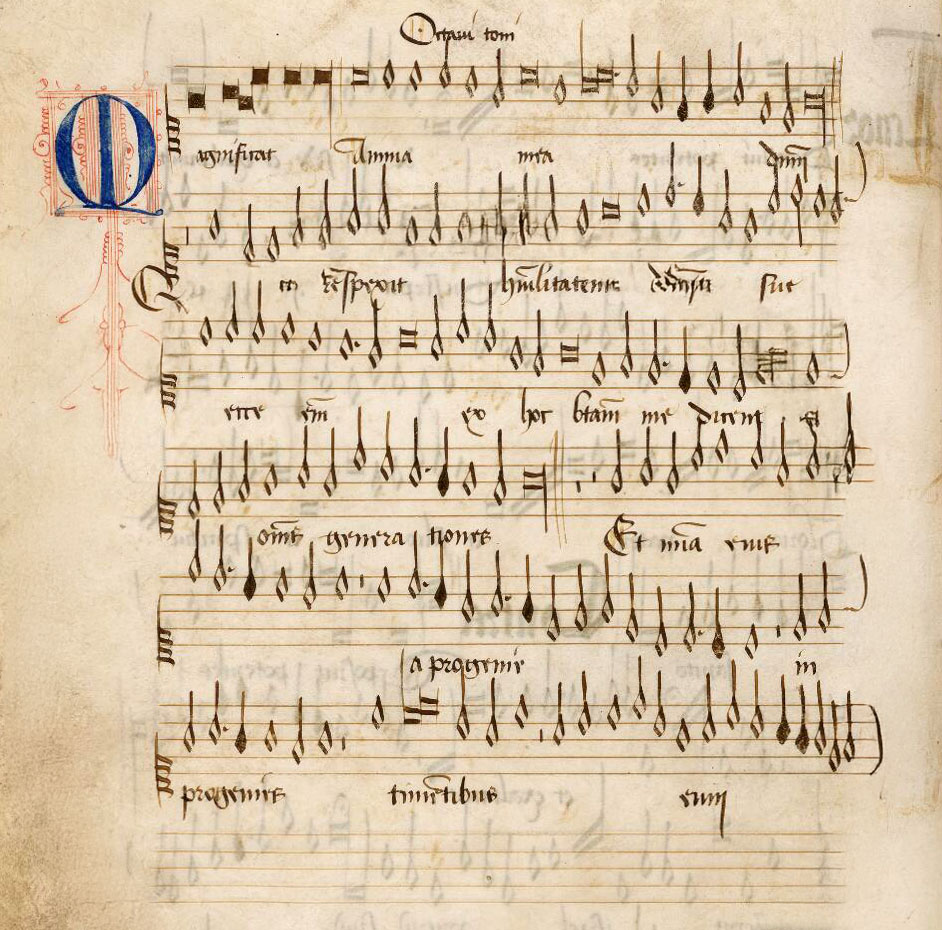
Dufay's Magnificat manuscript in the 1473 Vatican choir book that was readied for use in the new Sistine Chapel.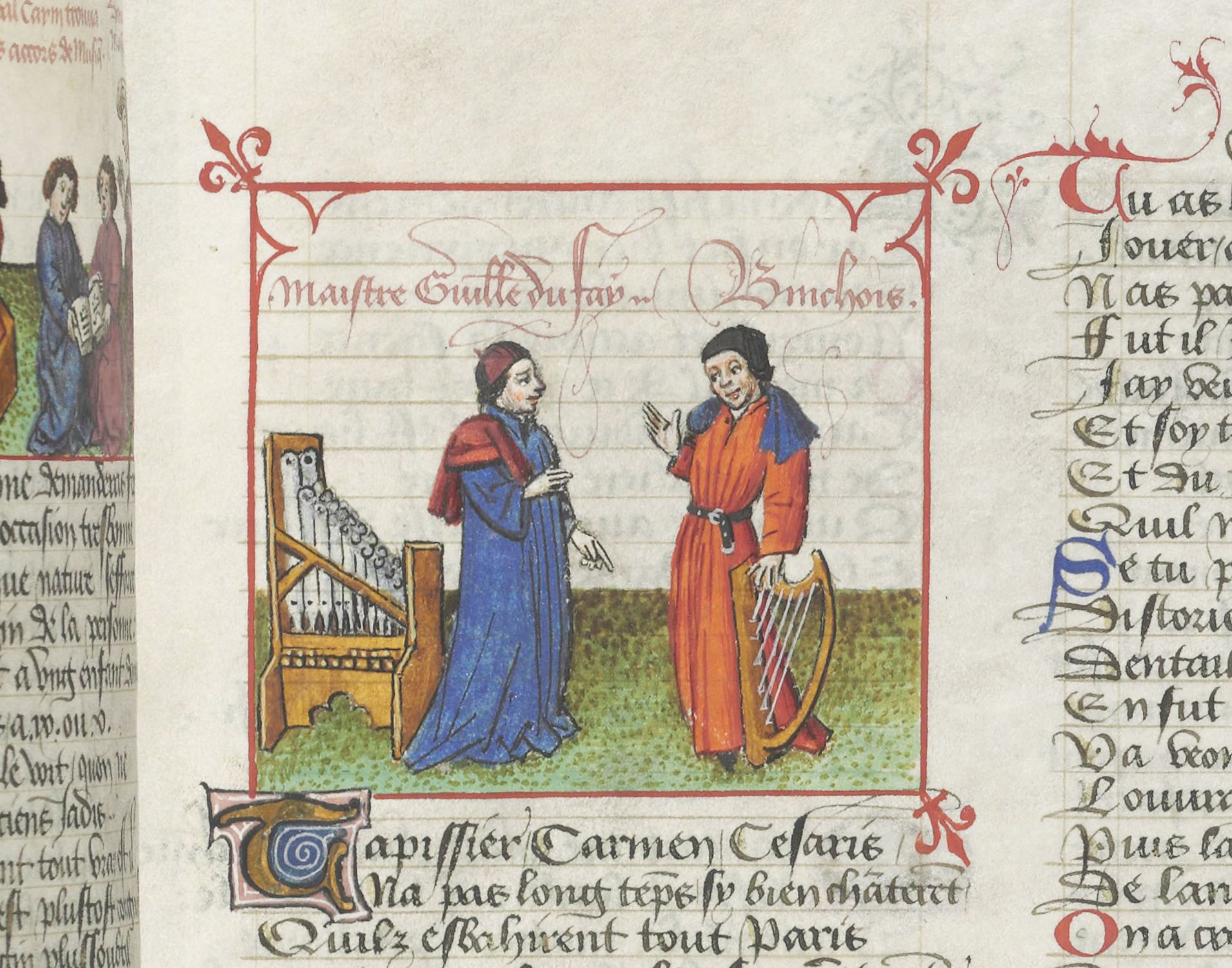
Dufay shown in a 15th century manuscript.
Dufay portrait.
O Magnum Mysterium
Tomás Luis de Victoria (Spain, 1548 – 1611)
O Magnum Mysterium is a responsory from the Holy Matins (Morning Prayer) of Christmas describing the wonderment of the animals as they gaze on Christ: “O great mystery and wonderful sacrament, that animals should see the newborn Lord, lying in a manger!”
O magnum mysterium
et admirabile sacramentum
ut animalia viderent Dominum natum
jacentem in praesepio!
Beata Virgo, cujus viscera
meruerunt portare Dominum Christum.
Alleluia
O great mystery
and wonderful sacrament
that animals should see the newborn Lord
lying in a manger!
Blessed is the virgin whose womb
was worthy to bear the Lord, Jesus Christ.
Praise God.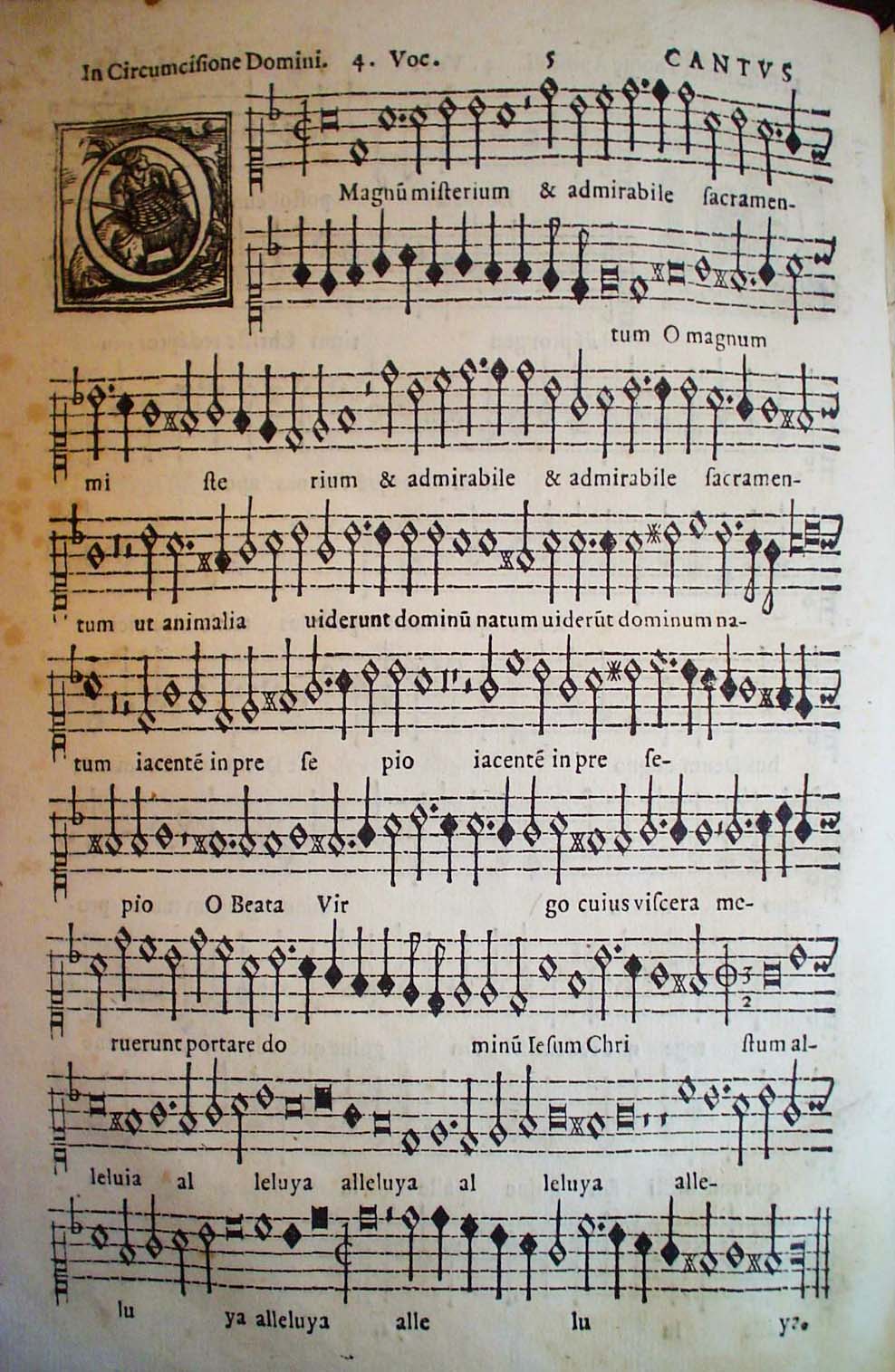
O Magnum Mysterium manuscript for the soprano voice.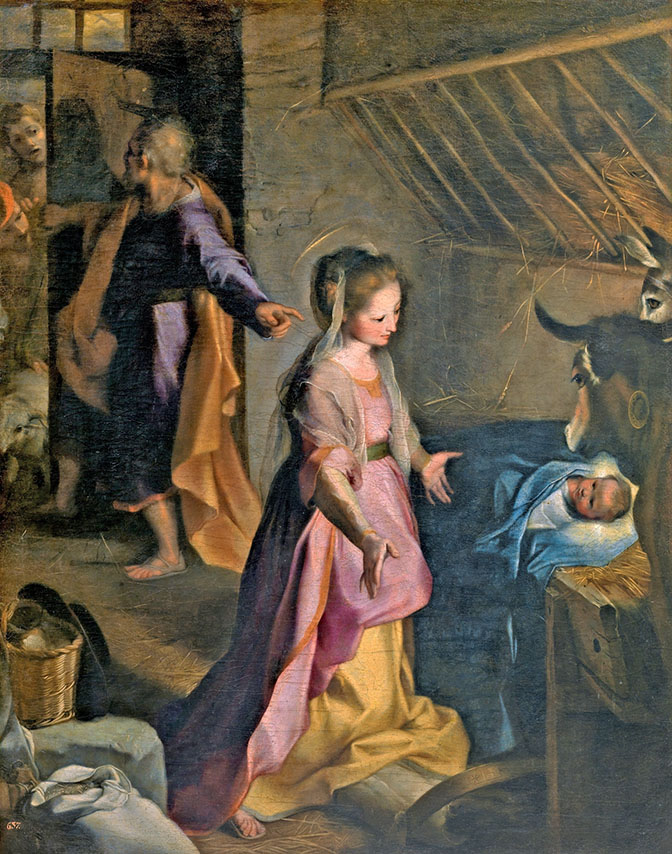
The Nativity is an oil on canvas painting by Italian painter Federico Barocci, created in 1597. It depicts the episode of the Nativity of Jesus, with the animals in the manger being the first to see the new born Christ child. It is held in the Museo del Prado, in Madrid, Spain.
Gabriel’s Message
Traditional Basque Christmas carol
Text: Rev. Sabine Baring-Gould (1834-1924)
Setting: Edgar Pettman (England, 1866–1943)
The first verses of this Basque carol tell of the angel Gabriel coming to Mary and informing her she will be the mother of the Christ child.
Mary responds and accepts this role in the following verses.
This carol borrows from a 13th century text that was paraphrased into English in 1922 by Rev. Sabine Baring-Gould (who had spent a winter as a boy in the Basque country).
1. The angel Gabriel from heaven came,
his wings as drifted snow, his eyes as flame;
"All hail," said he, "thou lowly maiden, Mary,
most highly favored lady," Gloria!
2. "For know a blessed Mother thou shalt be,
all generations laud and ho nor thee,
thy Son shall be Emmanuel, by seers foretold,
most highly favored lady," Gloria!
3. Then gentle Mary meekly bowed her head,
"To me be as it pleaseth God," she said,
"my soul shall laud and magnify His holy Name."
most highly favored lady," Gloria!
4. Of her, Emmanuel, the Christ was born
in Bethlehem, all on a Christ mas morn,
and Christian folk throughout the world will ever say
most highly favored lady," Gloria!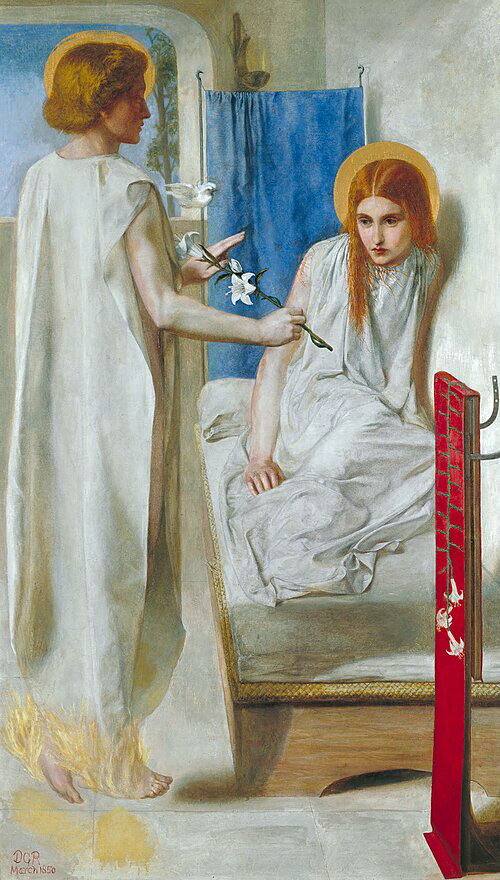
The overwhelmed Mary in an 1850 painting by Italy's Dante Gabriel Rosetti entitled "Ecce Ancilla Domini! "Behold the handmaiden of the Lord")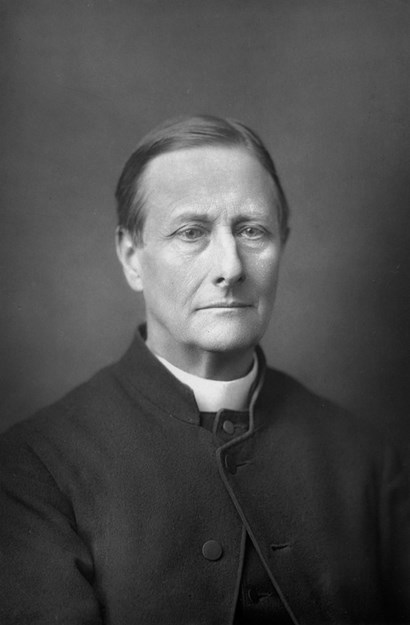
The Rev. Sabine Baring-Gould (1834-1924), in 1893
Hail! Blessed Virgin Mary!
17th century Traditional Italian Carol
Arr. Charles Wood (Ireland, 1866 – 1926)
Translation by Rev. George Ratcliffe Woodward (England, 1848-1934)
Charles Wood (whose students included Ralph Vaughan Williams) and Rev. Woodward (whose hobbies included beekeeping) were frequent collaborators. Woodward translated this hymn from Italian while Wood put it to music.
1. Hail! Blessed Virgin Mary!
For so, when he did meet thee
Spake mighty Gabriel,
and thus we greet thee.
Come weal, come woe, our
hymn shall never vary.
Hail! Blessed Virgin Mary!
Hail! Blessed Virgin Mary!
2. Ave! Ave Maria!
To gladden priest and people
The angelus shall ring
from every steeple,
To sound his virgin birth.
Alleluia!
Ave! Ave Maria!
Ave! Ave Maria!
3. Archangels chant, 'Hosanna!'
And, 'Holy! Holy! Holy!'
Before the Infant born
of thee, thou lowly,
Aye- maiden child of
Joachim and Anna.
Archangels chant Hosanna!
Archangels chant Hosanna!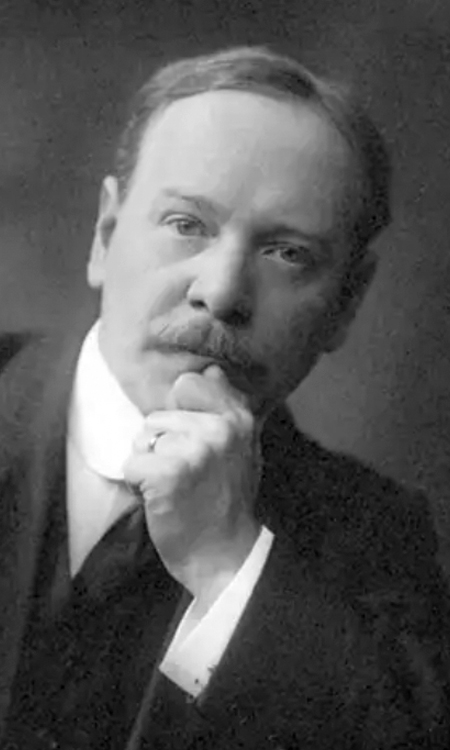
Charles Wood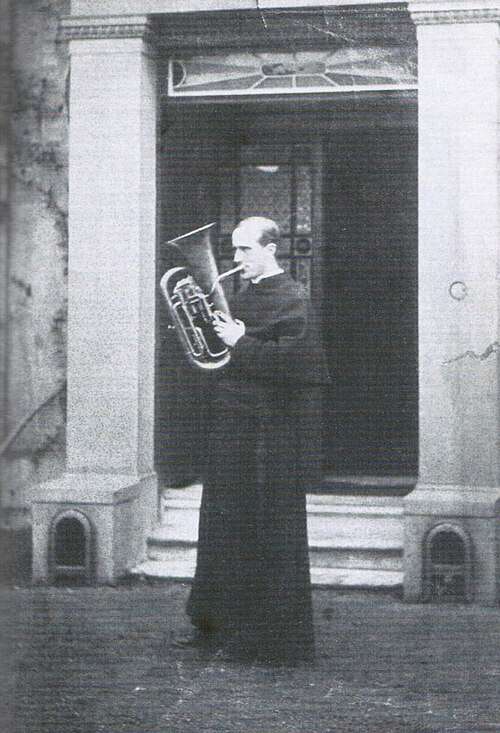
Rev. George Woodward
Once, as I remember
AKA Antururù
Arr. Charles Wood (Ireland, 1866 – 1926)
Translation by Rev. George Ratcliffe Woodward (England, 1848-1934)
"Antururù" refers to a rare and historical Italian Christmas lullaby first documented in a 1689 Italian collection titled Corona di sacre canzoni o laude spirituali.
This carol was translated and popularized in English by G.R. Woodward and composer Charles Wood in the 1920 ‘An Italian Carol Book’ under the title "Once, As I Remember".
1. Once, as I remember,
At the time of Yule,
After mid December,
When it bloweth cool,
I o'erheard a Mother
Was a-singing, 'Sweet Jesu,
La-lullay-lu, La-lullay-lu,
La-lullay-lu, La-lullay-lu.'
2. Near as man was able,
On my knee fell I,
in the Bethlem stable
Where the Babe did lie,
And the Virgin-mother
Was a-singing, 'Sweet Jesu,
La-lullay-lu, La-lullay-lu,
La-lullay-lu, La-lullay-lu.'
3. Ox and ass around him,
Courtier-like, did stand:
Fair white linen bound him,
Spun by Mary's hand.
While the Virgin-mother
Was a-singing, 'Sweet Jesu,
La-lullay-lu, La-lullay-lu,
La-lullay-lu, La-lullay-lu.'
4. Ever among and o'er us
Angel-quire gan sing
Antiphons in chorus
To the new-born King.
Then the Virgin-mother
Fell a-singing, 'Sweet Jesu,
La-lullay-lu, La-lullay-lu,
La-lullay-lu, La-lullay-lu.'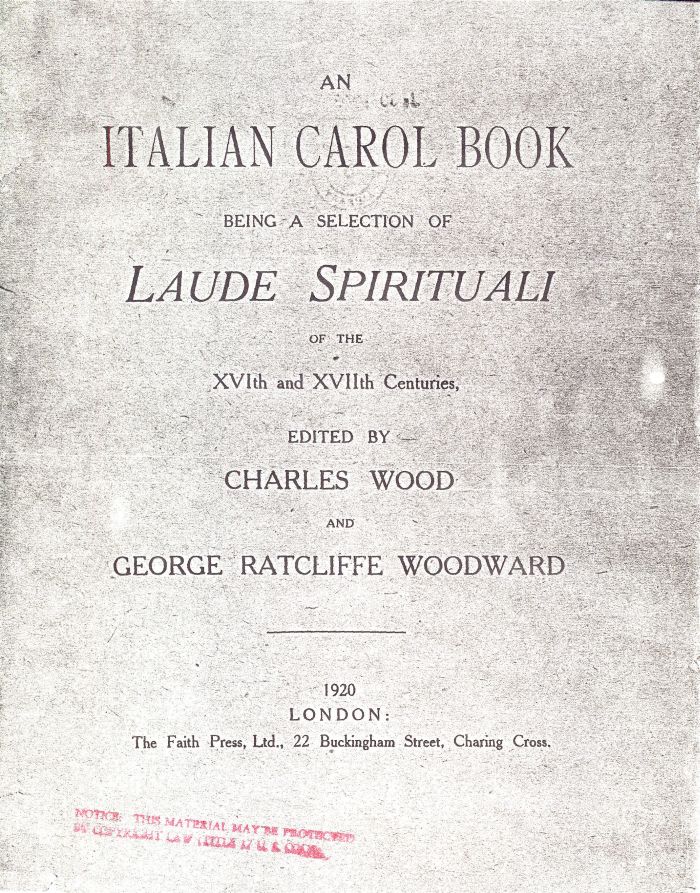
Wood and Woodward's Italian Carol Book cover.
Lord, Show Us Your Mercy and Love (Ps. 85)
Text: Psalm of the fifth century B.C
Setting: Janèt Sullivan Whitaker (USA, b. 1958)
Lord, show us your mercy and love.
1. I will hear what God proclaims,
the Lord for he proclaims peace.
near indeed is his salvation to those who fear him,
glory dwelling in our land.
2. Kindness and truth shall meet,
justice and peace shall kiss,
truth shall spring out of the earth
and justice shall look down from heaven.
3. The Lord himself will give his benefits,
our land shall yield its increase.
Justice shall walk before him,
and prepare the way of his steps. 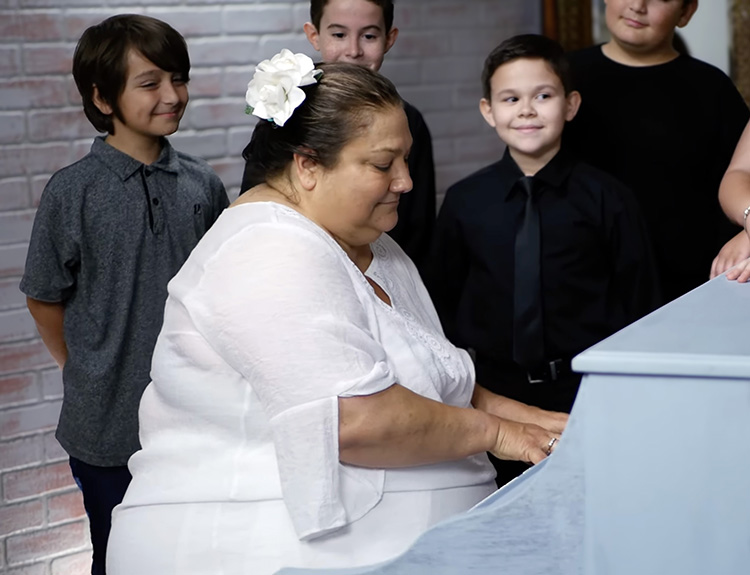
Janèt Sullivan Whitaker at the piano.
I Sing of a Maiden
Anonymous 15th century poem
This 15th century medieval poem from England celebrates the Annunciation and the Virgin Birth of Jesus. It’s text compares the quiet, gentle arrival of Christ to the Virgin Mary to dew falling softly on grass, flowers, and spray
The original poem had no music. This setting was composed by Schola’s Rev. Joe Vanderholt, S.J.
I sing of a maiden that is matchless.
King of all kings to her son she chose.
He came all so still there his mother was,
as dew in April that falleth on the grass.
Mother and maiden was never none, but she,
well may she God’s mother be.
Away in a Manger
Trad. 19th centuryEnglish Carol
Set to a traditional Normandy tune
Arr. Thomas Reginald Jacques (England, 1894 – 1969)
This popular carol set to an ancient Normandy tune.
Away in a manger, no crib for a bed,
The little Lord Jesus laid down his sweet head.
The stars in the bright sky looked down where he lay,
The little Lord Jesus asleep on the hay.
The cattle are lowing, the baby awakes,
But little Lord Jesus, no crying he makes.
I love thee, Lord Jesus! look down from the sky,
And stay by my cradle till morning is nigh.
Be near me, Lord Jesus; I ask thee to stay
Close by me forever, and love me I pray.
Bless all the dear children in thy tender care,
And take us to heaven to live with thee there.
Spotless Rose
Ola Gjeilo (Norway, b.1978)
The original text, which translates to "Lo, How a Rose E'er Blooming", dates back to 15th-century Germany. The author is unknown, though the earliest surviving manuscript is from the Carthusian Monastery of St. Alban in Trier. The lyrics draw on the messianic prophecy from the Book of Isaiah (11:1), using the rose as a metaphor for Jesus emerging from the ancestral root of Jesse, born of the "pure maiden" Mary.
A Spotless Rose is blowing,
Sprung from a tender root,
Of ancient seers’ foreshowing,
Of Jesse promised fruit;
Its fairest bud unfolds to light
Amid the cold, cold winter,
And in the dark midnight.
The Rose which I am singing,
Whereof Isaiah said,
Is from its sweet root springing
In Mary, purest Maid;
Through God’s great love and might
The Blessed Babe she bare us
In a cold, cold winter’s night.
Alleluia.
Abenlied
Josef Rheinberger (Bavaria, 1839–1901)
Text: Luke 24 v. 29
Rheinberger composed this six-part setting of Luke's text on March 9, 1855, a few weeks before Easter and only days before his 16th birthday.
Blieb’ bei uns, denn es will Abend warden;
Und der Tag hat sich geneiget, sich geneiget,
O bleib’ bei uns, denn es will Abend earden.
Bide with us, for evening shadows darken,
And the day will soon be over, soon be over,
O bide with us, for evening shadows darken.
Tr. John Rutter (b. 1945)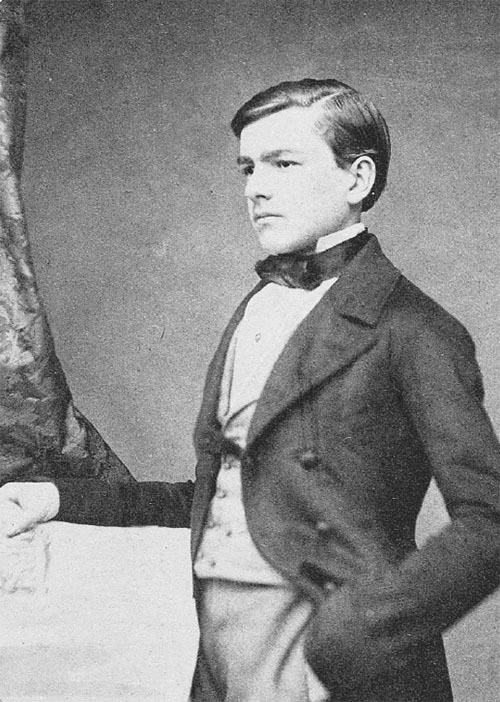
Rheinberger at 16 years of age - one year after he composed Abendlied.
Hallelujah Chorus from Messiah
George Frideric Handel (b. 1685 Germany, died 1759 England)
Handel composed Messiah in an astounding interlude, somewhere between three and four weeks in August and September 1741. The Hallelujah chorus is the last song in part two of this magnificent oratorio.
Hallelujah!
For the Lord God omnipotent reigneth.
The kingdom of this world is become the kingdom of our Lord,
and of His Christ;
And He shall reign for ever and ever.
King of kings, and Lord of lords.
Hallelujah!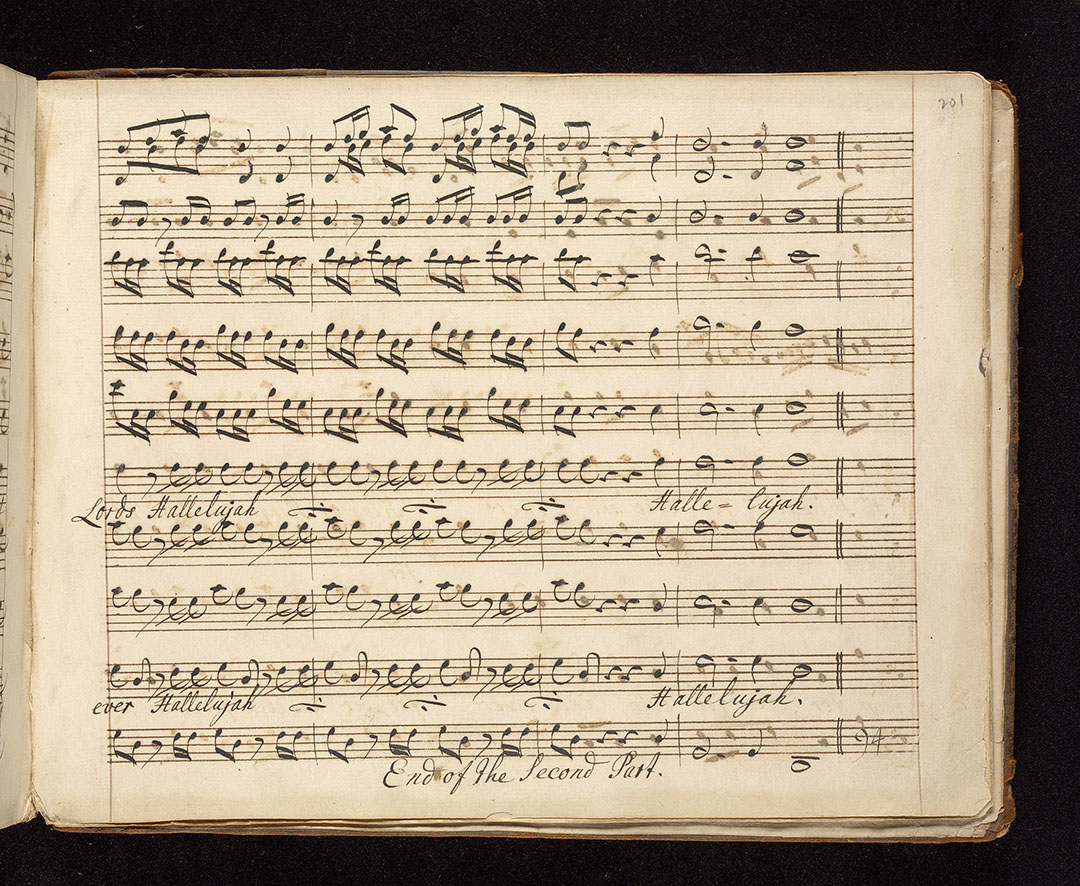
The last page of the Hallelujah chorus.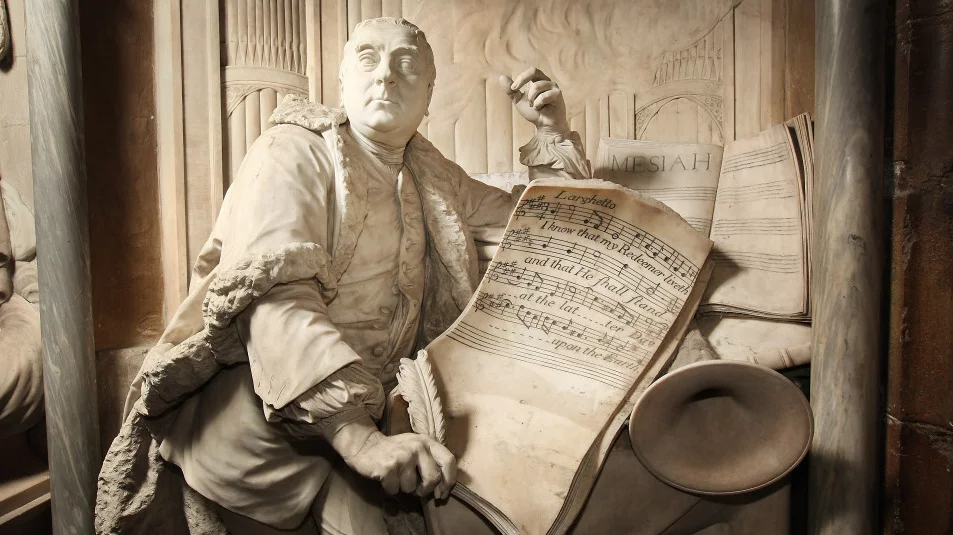
A statue of George Frederic Handel, posing with his Hallelujah in London's Westminster Abbey. Handel's one posthumous present to himself was £600 for his own monument at Westminster Abbey, final resting place for British monarchs and their most accomplished subjects. Three years after Handel's death, the monument by French sculptor Louis François Roubillac, was installed.
In dulci jubilo
14th German century medieval Christmas carol
Arr. Robert Lucas Pearsall (England, 1795-1856)
1. In dulci jubilo sweet jubilation
let us our homage show:
Our heart's joy reclineth
in præsepio; in the precept (instruction)
And like a bright star shineth
matris in gremio, in the mother’s lap
Alpha es et O! Beginning and end!
2. O Jesu parvule, O little Jesus
My heart is sore for Thee!
Hear me, I beseech Thee,
O puer optime; O child optimal (excelent)
My praying let it reach Thee,
o princeps gloriæ. o prince of glory
trahe me post te. draw me after you
3. O patris caritas! O fatherly love!
O Nati lenitas! O of the Son’s gentleness
Deep were we stained
per nostra crimina: because of our sins
But thou has for us gained
Cœlorum gaudia, Heaven’s joys
O that we were there
O that we were there!
4. Ubi sunt gaudia, Where are the joys?
If that they be not there?
There are Angels singing,
the bells are ringing there,
in Regis curia. in the King’s court
O that we were there!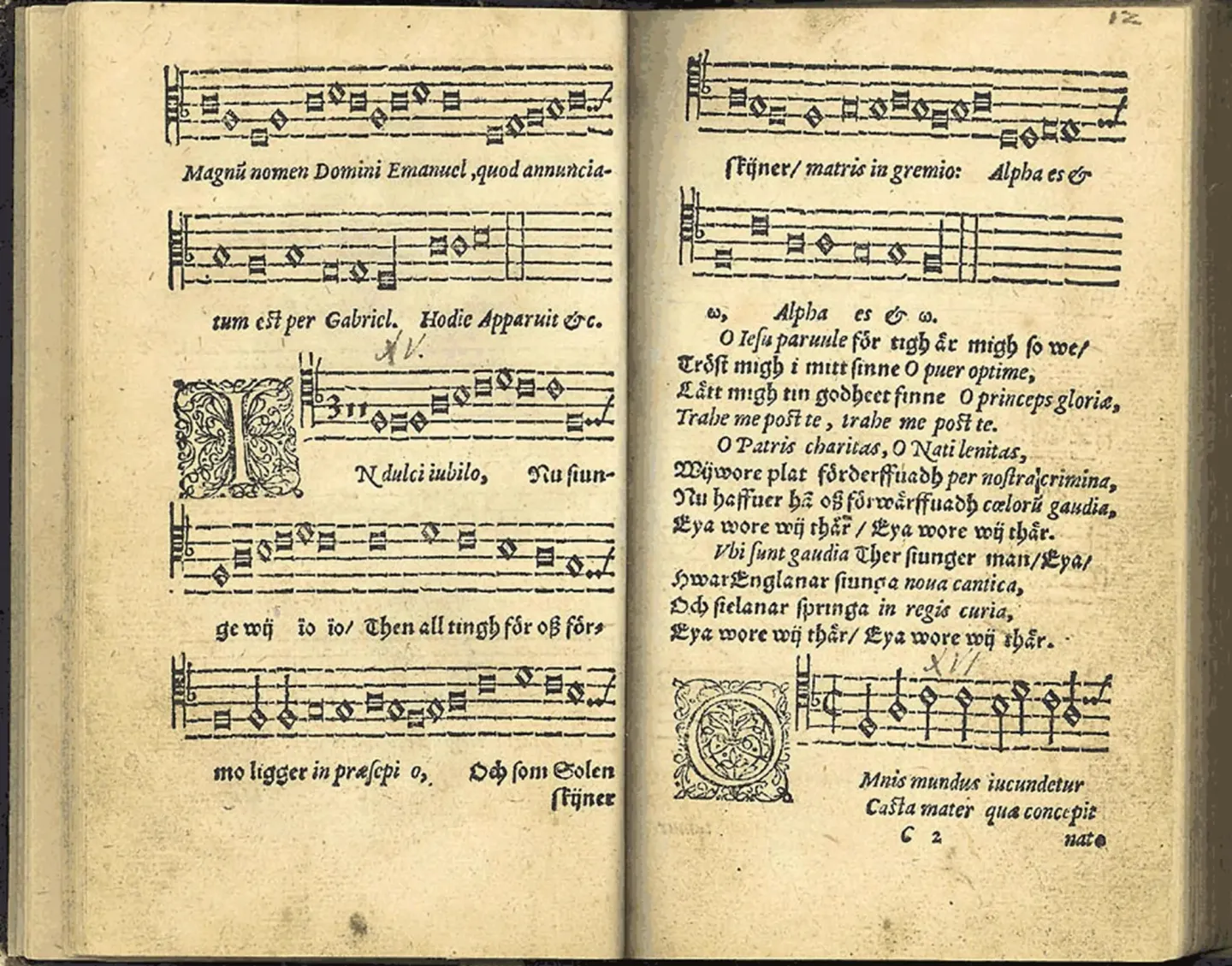
In dulci jubilo as it appears in the third edition of Piae Cantiones Ecclesiasticae, 1625, based on the first edition published in 1582.
Mañanitas a la Virgen de Guadalupe
Trad. of Nuestra Señora de Guadalupe
Las Mañanitas a la Virgen de Guadalupe is the traditional song of the ‘Patroness of the Americas, Our Lady of Guadalupe.’ Las Mañanitas is our song of greeting to 'her,' where we celebrate Juan Diego’s encounter with the Virgin Mary in 1531, greeting her as 'Guadalupana'. The Feast of Our Lady of Guadalupe is on December 12th.
1.
Oh Virgen, la más Hermosa del Valle del Anáhuac,
tus hijos muy de mañana te vienen a saludar.
O Virgin, the most beautiful of the Valley of Anahuac,
your children come to greet you very early in the morning.
Estribillo
Despierta, Madre, despierta, mira que ya amaneció,
mira este ramo de flores que para ti traigo yo.
Refrain
Wake up, Mother, wake up, look at the dawn,
look at this bouquet that I bring to you.
2.
Recibe, Madre querida, nuestra felicitación,
hoy por ser el día tan grande de tu tierna aparición.
Receive, dear Mother, our congratulations,
For today being the great day of your tender appearance.
3.
Recibe, Madre querida, nuestra felicitación;
míranos aquí postrados y danos tu bendición.
Receive, dear Mother, our congratulations;
see at us here prostrate and give us your blessing.
4.
Tú brillaste, Virgen Santa, como estrella matinal,
anunciando la alborada que iba pronto a comenzar.
You shone, Holy Virgin, as the morning star,
announcing the dawn that was soon to begin.
5.
Ya viene alborando el día, qué linda está la mañana,
saludemos a María: buenos días, Guadalupana.
El cerro del Tepeyac escogiste por morada,
por eso te saludamos, buenos días, Guadalupana.
Ya viene amaneciendo, ya la luz del día nos dio,
levántate, Virgencita, mira que ya amaneció.
The day is already dawning, how beautiful the morning is,
Let’s say hello to Mary. ‘God morning Guadalupana!’
You chose the Tepeyac hill as your home,
so we greet you; Good morning, Guadalupana!
Dawn is coming, and the light of day is upon us.
Get up, little Virgin, look and see that it is already dawn!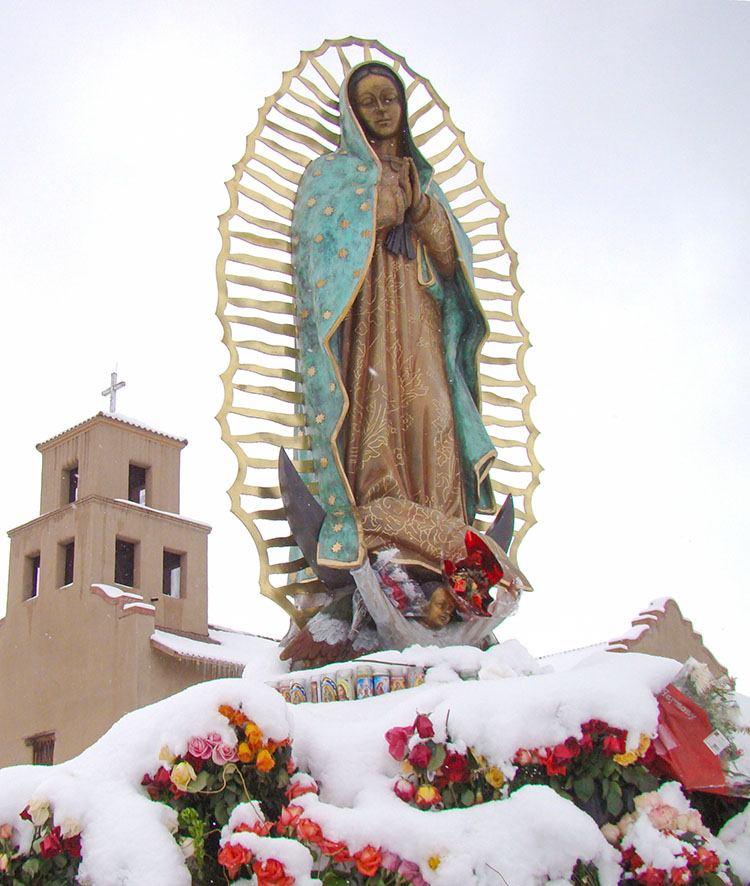
Santuario de Nuestro Señora de Guadalupe, Santa Fe.
Photo: Billy Turney
St. Jude Thaddeus 2026 Schola singers
Anna George - alto/tenor
Jackie Mattos - alto/soprano
Denise Moore - soprano
Susan Roller-Whittington - alto/soprano
Lucinda Sydow - alto/soprano/trumpet
Maestro Billy Turney - baritone/accordion
I want to be on Schola's email distribution!