SCHOLA CANTORUM OF SANTA FE
Santa Fe's Sacred Music Ensemble
Echoes of Mary Program
A Sacred Music Concert at Santa Fe’s Historic Rosario Chapel
I want to be on Schola's email distribution!
Salve Regina
11th century Gregorian chant
The author Salve Regina is unknown, but the strongest candidate seems to be Adhemar de Monteil (died 1098), bishop of Le Puy-en-Velay, who is said to have composed it for a processional chant for the Crusades. Indeed there are 12th century references to the Salve Regina as the "Antiphon of Puy"!
Salve, Regina, Mater misericordiæ:
vita, dulcedo, et spes nostra, salve.
Ad te clamamus exsules filii Hevæ.
Ad te suspiramus, gementes et flentes
in hac lacrimarum valle.
Hail, O Queen, Mother of mercy;
Our life, our sweetness, and our hope: hail!
To you we cry, poor banished children of Eve.
To you we send up our signs,
groaning and weeping in this valley of tears.
Eia, ergo, advocata nostra, illos tuos,
misericordes oculos ad nos converte;
Et Iesum, benedictum fructum ventris tui,
nobis post hoc exsilium ostende.
Hasten therefore, our Advocate,
and turn your merciful eyes toward us.
And show us Jesus, the blessed fruit
of your womb, after this exile.
O clemens, O pia, O dulcis Virgo Maria.
O merciful, O pious, O sweet Virgin Mary.
Ave Maria de Lourdes
Immaculate Mary
Ave, Ave, Ave Maria!
Ave, Ave, Ave Maria!
Miserere miseris
Medieval Irish chant
Arr. Michael McGlynn (Ireland, b. 1964)
This sequencia (chant to follow the Alleluia of the mass in medieval times) was written down in the 13th/14th century “Dublin Troper” song book. It is a prayer to St. Mary, and reflects the deep roots of Ireland’s monastic communities that date back to the 5th century.
Miserere miseris fons misericordie
Si misera fueris parit aula glorie,
Honor nostri generis,
Archa novi federis,
et aurora gracie.
Have mercy on the suffering, fount of mercy.
You bore the glorious prince in your great mercy.
Greatest of our race,
the new ark of the covenant,
and the dawn of grace.
Bogoróditse Devo
Sergei Rachmaninoff (Russa, 1873 – 1943)
This Russian version of the Ave Maria was included in Rachmaninoff's All-Night Vigil that was published just prior to the 1917 Bolshevik Revolution. That Revolution outlawed religion in Russia and curtailed its' performance in Rachmaninoff's homeland. This setting is so heavily influenced by the original religious chant that Rachmaninoff called it a "conscious counterfeit."
Богородице Дево, радуйся,
благодатная Марие, Господь с тобою.
Благословена ты в женах,
и благословен плод чрева твоего,
яко Спаса родила еси душ наших.
Mother of God, rejoice
Gracious Mary, the Lord is with you.
Blessed are you in women
and bless the fruit of your womb
As a Savior, you gave birth to our souls.
Ríu, ríu chíu
Anonymous
Traditional 15th century Spanish villancico
Ríu, ríu, chíu is the sound the shepherds made to call in their flock in this anonymous 15th century Spanish villancico (carol).
Ríu, ríu, chiu, la guarda ribera,
Dios guardó del lobo a nuestra cordera.
Muchas profecías lo har profetizado,
Y aún en nuestros días, lo hemos alcançado,
A Dios humanado vemos en el suelo,
Y al hombre en el cielo porque'l lo quisiera.
Mira bien que os cuadre que ansina lo oyera,
Que Dios no pudiera hazerla más madre;
El qu'era su Padre, oy d'ella nasçió,
Y el que la crió, su Hijo se dixera.
Este qu'es nasçido es el gran monarcha,
Christo patriarcha de carne vestido.
Ha nos redimido con se hazer chiquito,
Aunque era infinito, finito se hiziera.
Ríu, ríu, chíu, the riverside guard,
God saved our lamb from the wolf.
Many prophecies have prophesied it,
And even in our days, we have reached it,
We see God incarnate on the ground,
And to the man in heaven because he wanted it.
Take a good look to make sure that he has heard it,
That God could not make her more of a mother;
He who was her father, he was born from her,
And the one who raised her, her Son was said.
This is the birth of the great monarch,
Christ, God the father, dressed as a man.
He has redeemed us by becoming small,
Although he was infinite, he became finite.
Flos ut rosa floruit
14th century monastic chant
The manuscript containing the Marian Flos ut rosa floruit comes either from the Bavarian 12th century Augustinian monastery in Indersdorf, or from the 9th century St. Blaise Benedictine Abbey, both in southern Germany. Early literature suggests it was written in the early 15th century, but probably already existed in the second half of the 14th Century. The manuscript was located in the St. Blaise Abbey. It was purchased by the British Museum in 1867.
Flos ut rosa floruit quando virgo genuit Maria!
Salvatorem omnium, summi patris filium, nova genitura.
Qui divina gratia descendit ad infera humana
et salvavit omnia summa cum potentia, nova genitura.
Cantemus hymnum gloriae, cantico laetitiae laudando
sollemnizantes hodie regi regum justitiae gratias agendo
Qui natus est de Virgine mistico spiramine, nova genitura
Ergo nostra concio psallat cum tripudio benedicat Domino
A flower like a rose bloomed when the Virgin Mary gave birth!
The Savior of all, the Son of the Most High Father, a new generation.
Who by divine grace descended to the human underworld
and saved all things with supreme power, a new generation.
Let us sing a hymn of glory, a song of joy,
praising, celebrating today the King of kings, giving thanks.
Who was born of the Virgin by a mystical breath, a new generation
Therefore let our assembly sing with joy and praise the Lord.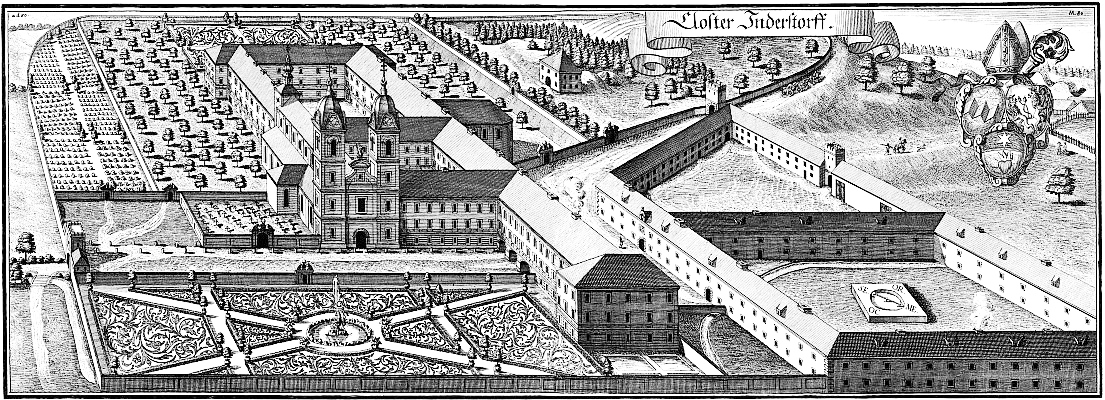
12th century Augustinian monastery in Indersdorf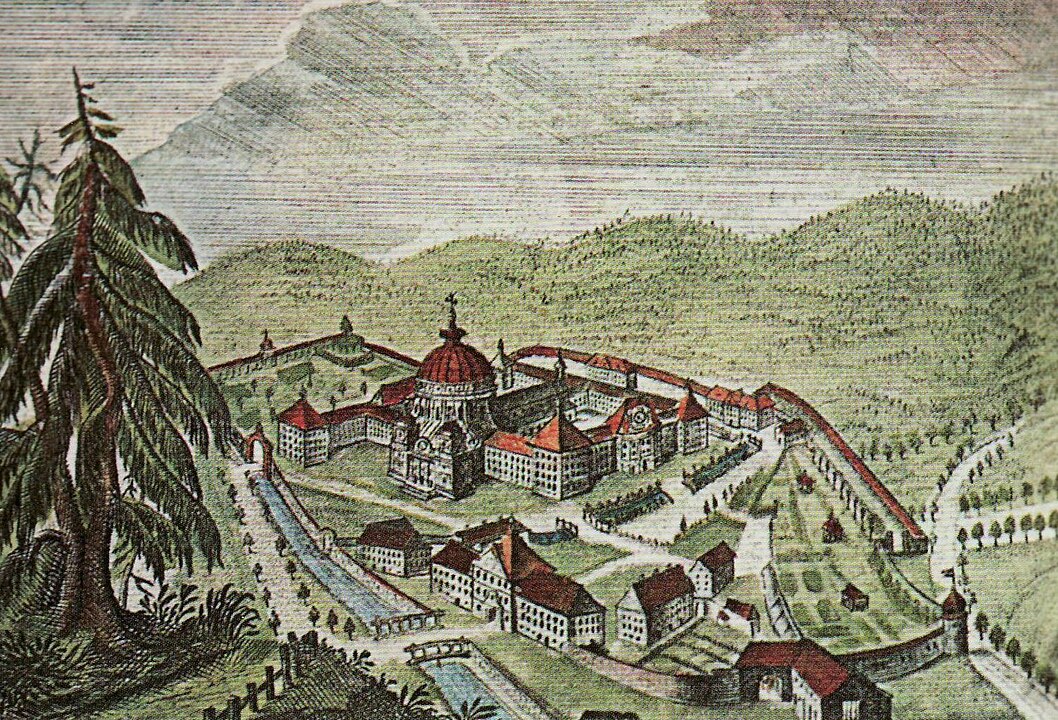
9th century St. Blaise Benedictine Abbey
El Noi de la Mare
The Child of the Mother
c.16th century Catalan lullaby
This lullaby’s melody can be traced to an 1820 organ notebook that is preserved in the Catedral de Santa Maria de la Seu Vella in Lleida, Catalonia, Spain. (This cathedral and its musical treasures was consecrated to the Virgin Mary on October 31, 1278.) The Hyperion label describes El Noi de la Mare’s style as “reflecting the musical culture of Catalonia.”
In typical medieval fashion, this tender Christmas song of Jesus' infancy points to his eventual condemnation and resurrection.
Què li darem an el Noi de la Mare?
Què li darem que li sàpiga bo?
Li darem panses amb unes balances,
li darem figues amb un paneró.
What will we give the Mother's Boy?
What will we give him that will taste good?
We will give him a tray full of raisins,
we will give him a basket of figs.
Què li darem al Fillet de Maria?
Què li darem al formós Infantó?
Panses i figues i nous i olives,
panses i figues i mel i mató.
What will we give the Son of Mary?
What will we give the beautiful Infant?
Raisins and figs and walnuts and olives,
raisins and figs and honey and curd.
Tam-pa-tam-tam que les figues són verdes,
Tam-pa-tam-tam que ja maduraran.
Si no maduren el dia de Pasqua,
maduraran en el dia del Ram.
Tam-pa-tam-tam, the figs are green,
Tam-pa-tam-tam, that they will ripen.
If they do not ripen on Easter Day,
they will ripen on Palm Sunday.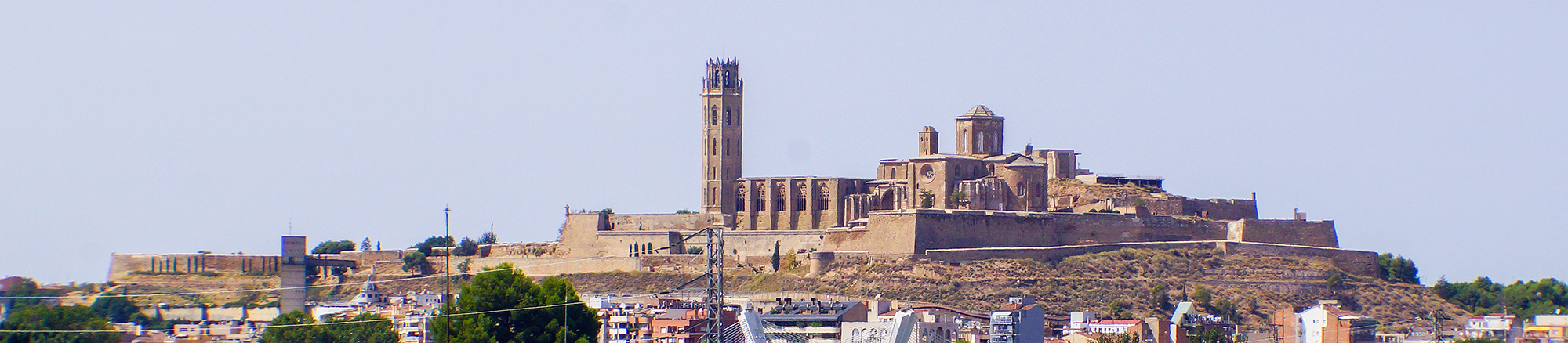
The Seu Vella Cathedral, that contains the earliest musical transcription of El No de la Mare, is the symbol of Lleida, Catalonia, being visible from its hilltop site anywhere in the city.
Spotless Rose
Ola Gjeilo (Norway, b.1978)
The original text, which translates to "Lo, How a Rose E'er Blooming", dates back to 15th-century Germany. The author is unknown, though the earliest surviving manuscript is from the Carthusian Monastery of St. Alban in Trier. The lyrics draw on the messianic prophecy from the Book of Isaiah (11:1), using the rose as a metaphor for Jesus emerging from the ancestral root of Jesse, born of the "pure maiden" Mary.
A Spotless Rose is blowing,
Sprung from a tender root,
Of ancient seers’ foreshowing,
Of Jesse promised fruit;
Its fairest bud unfolds to light
Amid the cold, cold winter,
And in the dark midnight.
The Rose which I am singing,
Whereof Isaiah said,
Is from its sweet root springing
In Mary, purest Maid;
Through God’s great love and might
The Blessed Babe she bare us
In a cold, cold winter’s night.
Alleluia.
Jerusalem
Traditional Irish melody
Arr. Michael McGlynn (Ireland, b. 1964)
The original 1616 manuscript of “Jerusalem,” with its traditional Irish melody, is based on the writings of St. Augustine. The manuscript is inscribed “A song made by F.B.P. to the tune of DIANA.” F.B.P. is thought to be Francis Baker Pater, a Catholic priest who was confined in the tower of London about the time of James I.
It is sung in the style of heterophony.
Sung by the ladies of Schola
Chorus.
Jerusalem, our happy home
When shall we come to thee?
When shall our sorrows have an end?
Thy joys when shall we see?
1. They see no one that sent her there
Their palms spring from the ground
No tongue can tell, no heart can think
What joys do there abound
2. Forever more the trees perfumed
And ever more they spring
And ever more the saints are glad
And ever more they sing
3. Fair Magdalene, she hath less moan
Likewise there she doth sing
The happy saints in harmony
Through every street doth ring
4. Fair Magdalene hath dried her tears
She'll weep no more to thee
Nor wet the ringlets of her hair
To wash her savior's feet
Ave Maris Stella
Esteban Salas y Castro (Cuba, 1725 - 1803)
Salas' music in considered baroque. Although Europe had moved on to the classical period by this time, the slower travel of musicians and their music from the Iberian peninsula (Spain) to New Spain delayed the arrival of classical style music to the Américas.
Salas mixed the 6th century Ave Maris Stella Gregorian chant with "new" baroque sounds. This chant has been a part of Vespers dedicated to St. Mary for more than 15 centuries.
1. Ave maris stella,
Dei Mater alma,
atque semper Virgo,
felix caeli porta.
Hail, Star of the Sea (Mary etymology),
loving Mother of God,
and Virgin immortal,
heaven's blissful portal.
2. Sumens illud Ave
Gabrielis ore,
funda nos in pace,
mutans Hevae nomen.
Receiving that "ave"
from the mouth of Gabriel,
establish us in peace,
reversing the name of Eva.
3. Solve vincla reis,
profer lumen caecis:
mala nostra pelle,
bona cuncta posce.
Break the chains of sinners,
bring light to the blind:
drive away our evils,
and ask for all good things.
4. Monstra t(e) esse matrem:
sumat per te preces,
qui pro nobis natus,
tulit esse tuus.
Show yourself to be a mother,
that, through you, he may accept our prayers.
He who, born for us,
chose to be your son.
5. Virgo singularis,
inter omnes mitis,
nos culpis solutos,
mites fac et castos.
Virgin incomparable,
meek above all other,
mac us, freed from our faults,
meek and chaste.
6. Vitam praesta puram,
iter para tutum:
ut videntes Iesum,
semper collaetemur.
Keep our life pure,
make our journey safe,
so that seeing Jesus,
we may rejoice together forever.
7. Sit laus Deo Patri,
summo Christo decus,
spiritui Sancto,
tribus honor unus.
Amen.
Let there be praise to God the Father,
and glory to Christ the most high,
and to the Holy Spirit,
and to the Three be on e honor.
So be it.
Nos sumus in mundo
Hildegard von Bingen (Germany, 1098–1077)
From Hildegard’s Symphony of Virgins (O dulcissime amator)
Nos sumus in mundo
et tu in mente nostra,
et amplectimur te in corde
quasi habeamus te presentem.
We live within the world,
and you within our minds,
and we embrace you in our hearts
as if you’re present even now.
Quasi aurora
Hildegard von Bingen (Germany, 1098–1077)
From Hildegard’s Responsory for the Virgin
Filius Dei per
secreta ipsius quasi aurora exivit.
The Son of God came forth,
through her secrets, like the dawn.
Canto de María
Mary's Song - Magnificat
Rev. Monsignor Lambert Luna (New Mexico, b. 1952)
New Mexico's Monsignor Lamber Luna composed this setting of the Magnificat in the Spanish language.
Proclama mi alma la grandeza del Señor.
Se alegra mi espíritu en Dios mi Salvador.
My soul proclaims the greatness of the Lord.
My spirit rejoices in God my Savior.
1. Porque ha mirado la⏝humillación de su⏝esclava, de su⏝esclava.
Desde⏝ahora todas las gentes siempre me felicitarán.
1. For He has looked upon the lowliness of His handmaid.
From now on, all generations shall call me blessed.
2. Porque⏝el Poderoso ha hecho obras grandes por mí,
porque⏝el | Poderoso es Santo, su nombre es San-to.
2. For the Mighty One has done great things for me,
for the Mighty One is Holy; His name is Holy.
3. Y su misericordia llega a sus fieles hoy y siempre;
hace proezas con su brazo, dispersa⏝a los sober-bios.
3. And His mercy reaches the faithful today and forever;
He performs mighty deeds with His arm; He scatters the proud.
4. A los poderosos derriba de sus tronos, los derriba,
y⏝enaltece a los humildes, los humildes de corazón.
4. He casts down the mighty from their thrones, casts them down,
and exalts the the humble of heart.
5. A los ham-brientos los colma de sus bienes, Dios los colma,
y⏝a los ricos los despide, los despide vacíos.
5. He fills the hungry with good things — God fills them —
and sends the rich away, sends them away empty.
6. Auxilia a Israel, Israel su siervo,
acordándose con ternura de su misericordia.
6. He comes to the aid of Israel, Israel His servant,
remembering His mercy with tenderness.
7. Como⏝a nuestros padres lo⏝había prometido, prometido,
en favor de Abrahán y su descenden-cia.
7. Just as He had promised our ancestors, promised,
for the sake of Abraham and his descendants.
Los Peces en El Río
Traditional 16th century Villancico of Spain
This popular Spanish villancico seems to draw a contrast between the fishes in the river, who are excited about the birth of Jesus, and the Virgin Mary and her chores of daily life.
But this villancico is filled with complexity – hidden meanings, Moorish (Arabic) musical structure and tonalites, transformation of a secular song into a religious song (as was popular in 16th century Spain where secular texts were adapted "to the divine," transforming them into compositions with religious content), and hidden imagery (the Virgin is combing her golden hair with a comb made of silver – a nod to Spain’s Golden Age of 1492 to 1681).
La Virgen se está peinando
entre cortina y cortina,
sus cabellos son de oro
y el peine de plata fina.
The Virgin is combing her hair
between the curtains,
her hairs are of gold
and the comb is of fine silver.
Estribillo:
Pero mira como beben los peces en el río,
pero mira como beben por ver a Dios nacido.
Beben y beben y vuelven a beber,
los peces en el río por ver a Dios nacer.
Refrain:
But look how the fishes in the river drink,
but look how they drink to see God born.
They drink, and drink, and drink again,
the fishes in the river to see God born.
La Virgen lava pañales
y los tiende en el romero,
los pajarillos cantando
y el romero floreciendo.
The Virgin washes diapers
and hangs them in the rosemary,
the birds are singing
and the rosemary is flowering.
La Virgen se está lavando
con un poco de jabón,
se le han picado las manos
manos de mi corazón.
The Virgin washes herself
with a little bit of soap,
her hands have become itchy,
the hands of my heart.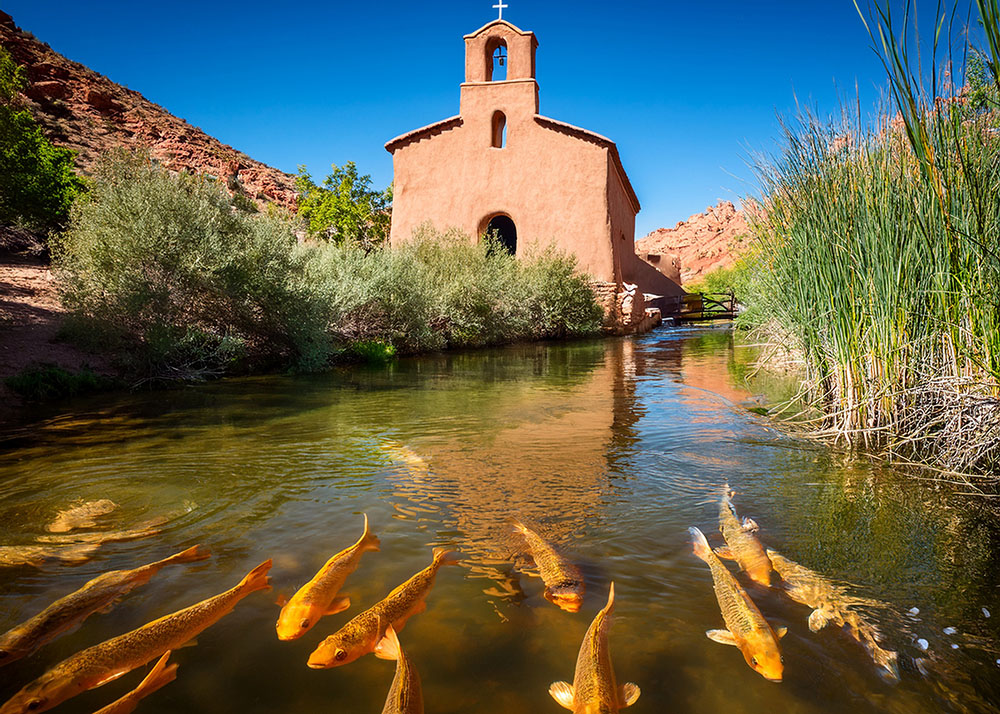
Mañanitas a la Virgen de Guadalupe
Trad. of Nuestra Señora de Guadalupe
Las Mañanitas a la Virgen de Guadalupe is the traditional song of the ‘Patroness of the Americas, Our Lady of Guadalupe.’ Las Mañanitas is our song of greeting to 'her,' where we celebrate Juan Diego’s encounter with the Virgin Mary in 1531, greeting her as 'Guadalupana'. The Feast of Our Lady of Guadalupe is on December 12th.
1.
Oh Virgen, la más Hermosa del Valle del Anáhuac,
tus hijos muy de mañana te vienen a saludar.
O Virgin, the most beautiful of the Valley of Anahuac,
your children come to greet you very early in the morning.
Estribillo
Despierta, Madre, despierta, mira que ya amaneció,
mira este ramo de flores que para ti traigo yo.
Refrain
Wake up, Mother, wake up, look at the dawn,
look at this bouquet that I bring to you.
2.
Recibe, Madre querida, nuestra felicitación,
hoy por ser el día tan grande de tu tierna aparición.
Receive, dear Mother, our congratulations,
For today being the great day of your tender appearance.
3.
Recibe, Madre querida, nuestra felicitación;
míranos aquí postrados y danos tu bendición.
Receive, dear Mother, our congratulations;
see at us here prostrate and give us your blessing.
4.
Tú brillaste, Virgen Santa, como estrella matinal,
anunciando la alborada que iba pronto a comenzar.
You shone, Holy Virgin, as the morning star,
announcing the dawn that was soon to begin.
5.
Ya viene alborando el día, qué linda está la mañana,
saludemos a María: buenos días, Guadalupana.
El cerro del Tepeyac escogiste por morada,
por eso te saludamos, buenos días, Guadalupana.
Ya viene amaneciendo, ya la luz del día nos dio,
levántate, Virgencita, mira que ya amaneció.
The day is already dawning, how beautiful the morning is,
Let’s say hello to Mary. ‘God morning Guadalupana!’
You chose the Tepeyac hill as your home,
so we greet you; Good morning, Guadalupana!
Dawn is coming, and the light of day is upon us.
Get up, little Virgin, look and see that it is already dawn!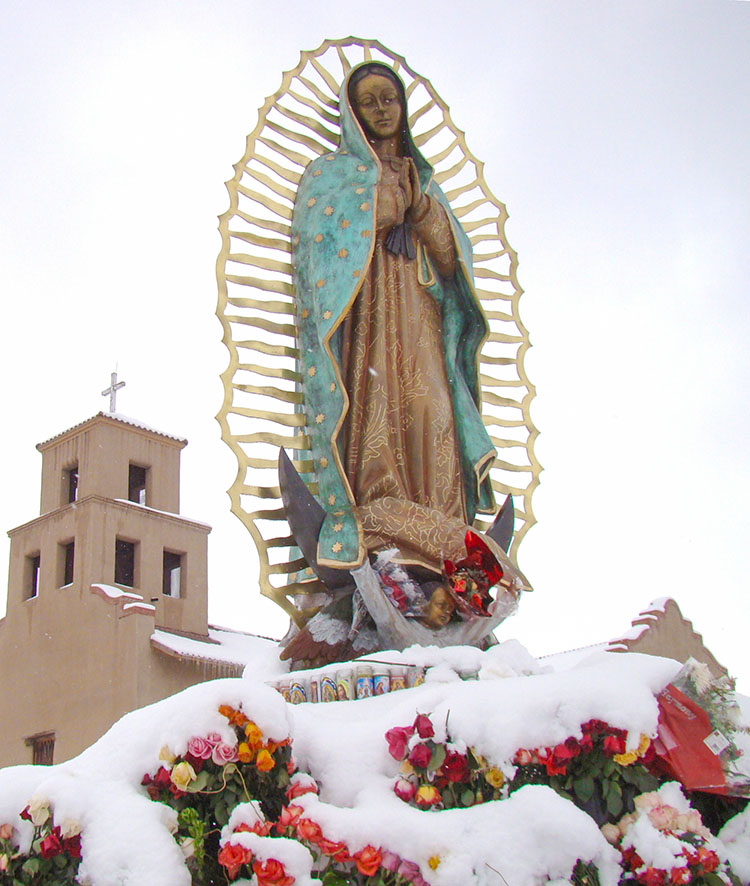
Santuario de Nuestro Señora de Guadalupe, Santa Fe.
Photo: Billy Turney
Angelus Domini
Franz Xaver Biebl (Germany, 1906 – 2001)
The praying of the “Angelus” originated in 11th century Europe. As the bells rang in monasteries at dawn, noon and dusk, the custom of chanting the Ave Maria, interspersed with scripture passages, took hold. Biebl composed this setting of the Angelus in 1964 at the request of a choir of firemen in the Fürstenfeldbruck parish near Munich, Germany.
[℣.] Angelus Domini nuntiavit Mariæ;
[℟.] Et concepit de Spiritu Sancto.
[℣.] The Angel of the Lord declared unto Mary
[℟.] And she conceived of the Holy Spirit.
Ave Maria, gratia plena, Dominus tecum.
Benedicta tu in mulieribus,
et benedictus fructus ventris tui, Jesus.
Hail Mary, full of grace, the Lord is with thee.
Blessed art thou amongst women,
and blessed is the fruit of thy womb, Jesus.
[℣.] Ecce ancilla Domini.
[℟.] Fiat mihi secundum verbum tuum.
[℣.] Behold the handmaid of the Lord.
[℟.] Be it done unto me according to your word.
Ave Maria…
[℣.] Et Verbum caro factum est. (In actual practice, here all bow reverently or genuflect.)
[℟.] Et habitavit in nobis.
[℣.] And the Word was made Flesh.
[℟.] And dwelt among us.
Ave Maria…
Sancta Maria, Mater Dei,
ora pro nobis peccatoribus,
nunc, et in hora mortis nostrae.
Amen.
Holy Mary, Mother of God,
pray for us sinners
now and at the hour of our death.
And so it shall be.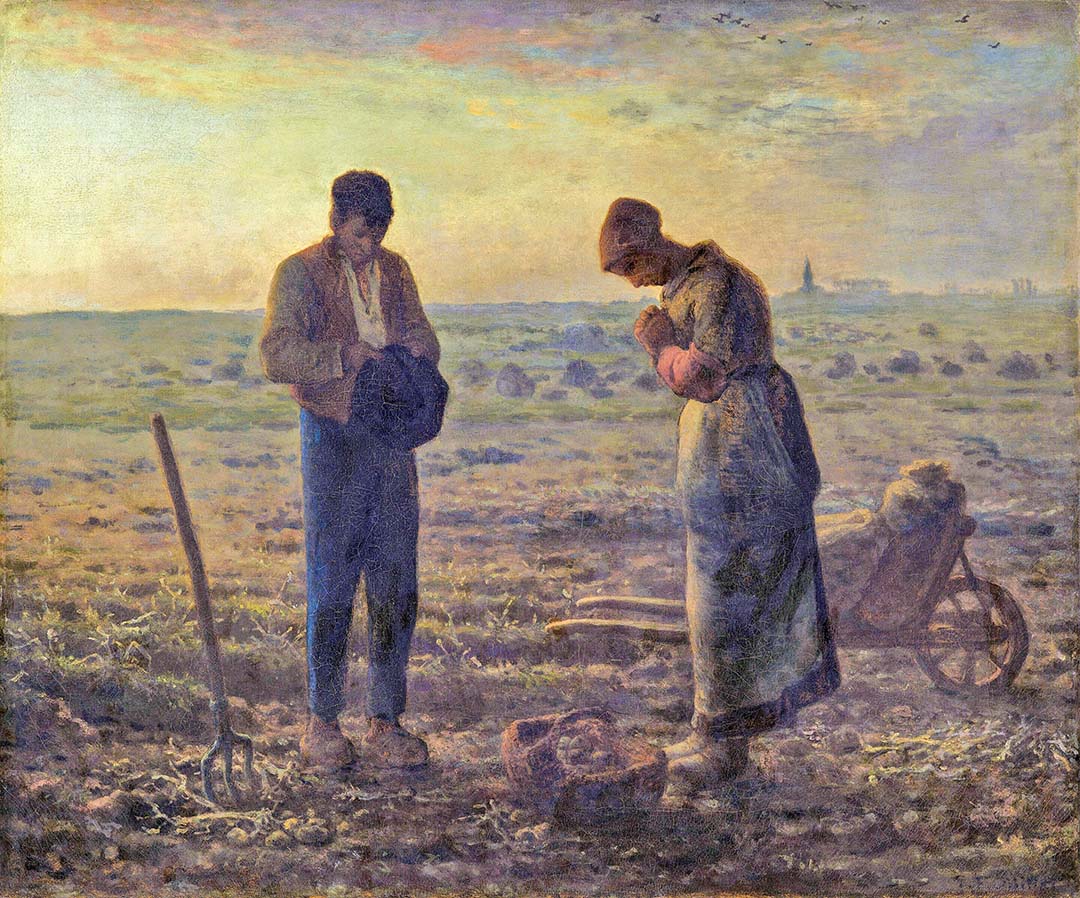
Jean-Francois Millet (France, 1814-1875). Millet said of his painting; "The idea for The Angelus came to me because I remembered that my grandmother, hearing the church bell ringing while we were working in the fields, always made us stop work to say the Angelus prayer for the poor departed."
Rosario Chapel 2026 Schola singers
Jackie Mattos - alto/soprano
Denise Moore - soprano
Susan Roller-Whittington - alto/soprano
Lucinda Sydow - alto/soprano
Maestro Billy Turney - baritone/accordion
I want to be on Schola's email distribution!